.jpg)

Good hotel front desk training is a system. It teaches the right skills, delivers them consistently across every shift and every property, and proves they stuck. Most advice online provides a checklist and stops there. But the information you'll find here is for leaders who own front desk training, whether that's a single owner-manager or a training team running it across dozens of properties.
Key takeaways
- Good front desk training is a system: teach the right things, deliver them consistently, and check whether they worked, not just a list of skills.
- Seasonal hiring and high turnover mean training needs to work in short, mobile modules a new hire can finish before their first shift.
- Real measurement ties training to guest-facing outcomes like satisfaction scores and complaint volume, not just completion rates.
Gaps in hospitality training, including hotel front desk training, shows up fastest in the moments nobody specifically trained for. It might be an 11 p.m. shift where a new hire is alone at the desk and they're confronted by a displeased guest with a canceled reservation. Or when they're alone with a lineup out the door and the phones ringing off the hook. But a great training program doesn't drill every possible scenario. It trains for what those moments have in common, like staying calm, knowing where to look, and knowing who to call.
This article covers what to teach, but it spends more time on information about how hotels get training delivered and tracked at scale, and how to know if it worked. See Hotel staff training for every role in your business for a broader look at training for hotel roles.
What does hotel front desk training need to cover?
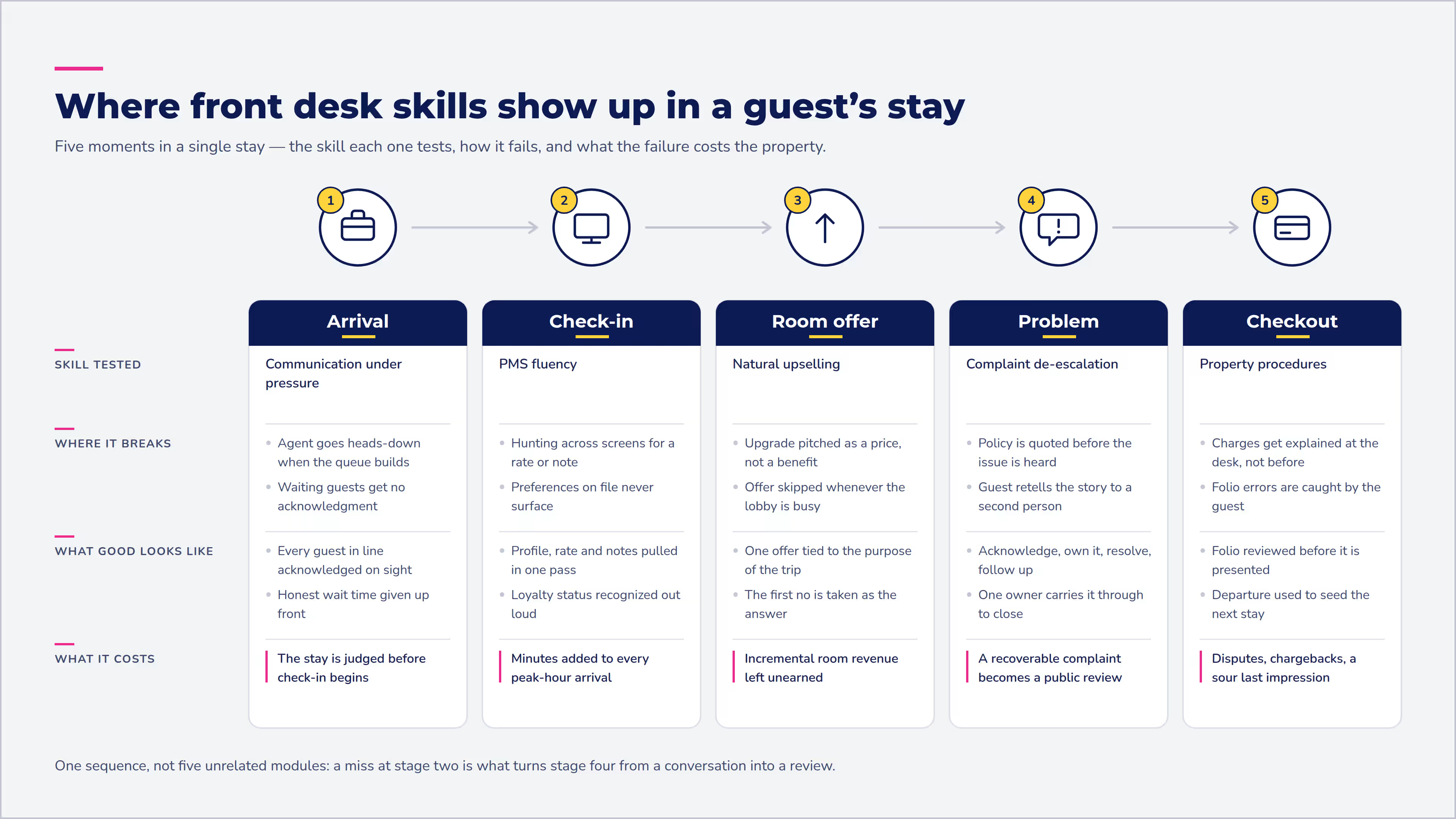
Hotel front desk training needs to cover five skills: guest communication under pressure, property management system (PMS) fluency, natural upselling, complaint de-escalation, and property-specific procedures.
1. Guest communication under pressure
Guest communication under pressure means staying composed with an unhappy guest, a language barrier, or a line forming behind them. It's the skill guests notice first.
How to train it: Short role-play scenarios where employees can safely rehearse. See the capabilities of Absorb Aura's Rehearse agent (coming soon).
2. Property management system (PMS) fluency
PMS fluency is the mechanical backbone of the front desk, whether your property runs OPERA Cloud, Mews, or something else. An agent who fumbles the checkout screen while a guest waits looks unprepared even if they aren't.
How to train it: Practice in a sandbox environment before going live.
3. Upselling that sounds natural
Good upselling sounds like a helpful suggestion. "We have a room with a better view for $20 more a night" works because it's specific and easy to decline.
How to train it: Short video examples of real offers, followed by practice.
4. Complaint handling and de-escalation
Complaint handling is de-escalation: acknowledge the problem, offer a real fix, and know when to bring in a manager. Most front desk complaints trace back to a guest who felt unheard, so acknowledgment comes before any fix.
How to train it: Scenario branching with clear escalation thresholds.
5. Property-specific procedures
Property-specific procedures are the check-in, check-out, payment, and local details that no generic course covers.
How to train it: Short property-built modules that are updated whenever a procedure changes.
How is training different for a five-person independent inn versus a 500-room chain property?
Training at an independent inn and training at a chain property cover the same skills but solve completely different delivery problems. An independent inn's owner-manager can train one new hire at a time, standing next to them at the desk. A 500-room chain property needs the same quality of training delivered consistently across dozens of locations, shift patterns, and managers who've never met each other.
That's the real tension between consistency and flexibility. A small property can adapt training on the fly because one person controls all of it. A chain can't rely on that. If training lives only in one manager's head, it doesn't scale past that manager.
Property type | How training gets delivered | Where consistency breaks down |
|---|---|---|
Independent inn | Owner-manager trains each hire one-on-one at the desk | Depends entirely on one person's time and memory |
Regional or small chain | Corporate materials plus local onboarding at each property | Local managers adapt it their own way, so quality varies by location |
National or global chain | A corporate team pushes standardized modules to every property and tracks completion centrally | Rollout speed across hundreds of properties, especially during manager turnover |
Hotel staff training and front desk training specifically overlap here but aren't identical. Staff training covers the whole team, including housekeeping, food and beverage, and maintenance. Front desk training is narrower.
It's the guest-facing role where a bad five minutes becomes a bad review. A property that treats them as the same program usually shortchanges the front desk.
How do hotels train front desk staff fast during seasonal hiring surges?
Fast hotel front desk training during a seasonal surge means short, mobile modules a new hire can finish before their first shift. It's not a multi-week onboarding program they'll never get through. Speed matters because seasonal hires often start with days, not weeks, of runway.
The accommodation and food services industry posted a quits rate of 3.5 percent in the most recent month tracked by the U.S. Bureau of Labor Statistics. That's among the highest of any major industry group. More than half of hotels report being somewhat or severely understaffed, according to the American Hotel & Lodging Association.
Turnover and understaffing aren't occasional problems in this industry. They're the baseline.
A ten-minute module a new hire completes on their phone between check-ins beats a two-hour classroom session nobody has time to schedule. Bite-sized training also fits how front desk shifts work, in five- or ten-minute gaps between guests rather than one uninterrupted block.
This is where the delivery tool matters as much as the content. An LMS built for this kind of workforce pushes short modules to a phone, tracks who finished what, and flags who's falling behind before their first solo shift — no spreadsheet required. The same principle applies to hotel staff training overall. If it isn't built for a five-minute gap between guests, it won't get used.
"When building a business case for upskilling, start small; find an example group, identify a specific skill gap or business problem you are trying to solve, run a targeted program, and measure it. Then use that as your proof point to demonstrate the ROI and drive broader adoption. Once you can show the before‑and‑after story, the case for scaling becomes straightforward.”
—Devan Graham, Sr. Human Resources Business Partner, Absorb LMS
What software or tools do hotels use to deliver front desk training?
Hotels deliver front desk training through a mix of in-person shadowing, printed manuals, and, increasingly, hospitality training software. Most properties still rely on some combination of the first two, and most also have no reliable way to confirm the training happened.
That gap is the real problem. A binder in a back office doesn't tell you who read it. Shadowing a veteran employee for a shift doesn't tell you what got covered. A hospitality LMS closes that gap by tracking completion automatically, the same way it delivers the content.
Look for three things in a training platform. It should offer mobile access, since most front desk staff aren't sitting at a desktop between shifts, plus automatic completion tracking and visibility across multiple properties if you manage more than one. Anything less puts you back to the binder-and-shadowing system, with extra software layered on top.
Hospitality training software is worth it even for a single independent property. The math changes with scale, but the underlying problem stays the same at every size. It's proving training happened instead of hoping it did.
How do you know if hotel front desk training worked?
You know hotel front desk training worked when it shows up in outcomes, not just completion reports. A hundred percent completion tells you everyone clicked through the material. It doesn't tell you anyone learned it.
Real measurement ties training to something a guest would notice, like satisfaction scores, complaint volume, or upsell conversion. According to EHL Hospitality Business School, the quality of service hotel staff provide is one of the most significant factors in guest satisfaction. That service quality traces back to training, so a drop in satisfaction scores is often a training problem before it's a staffing problem.
A mystery-shop-style spot check works too. Have a manager, or a trusted regular, run through a check-in and rate the experience against what training covered. It's low-tech, but it catches what a completion dashboard never will. It shows whether the training changed behavior at the desk, not knowledge on a quiz.
Most advice on hotel front desk training stops here. Plenty of guides tell you what to teach. Almost none tell you how to find out if it worked.
How multi-property hotels keep training consistent: Lessons from A&W Canada
Multi-property hotels have the same training problem as restaurant franchises. Each location runs its own onboarding, so quality depends on who's doing the training. A&W Canada solved this by putting every new hire at more than 900 independently managed restaurants through one mandatory program on Absorb LMS. It was built for staff with a wide range of languages and comfort with technology.
Where the franchise model maps to the front desk
Front desk challenge | What A&W's rollout shows |
|---|---|
Property-specific procedures | Every new hire gets the same core training from the same materials, at every location. Hotels can standardize brand standards the same way and keep property modules separate. |
Guest communication across languages | The training was designed for "a lot of different languages and different familiarities with technology." That's the same range as a typical front desk team. |
Many people owning training | A&W had "thousands of admins," each running training for their own restaurant. It's the same setup as general managers running onboarding at each property. |
"It's so intuitive. We have a wide range of people joining our team, including a lot of different languages and different familiarities with technology."
Emily Duholke, Manager of Restaurant Training & Transformation, A&W Canada
Read the full A&W Canada customer story.
Front desk training that holds up
Front desk training holds up when it works as a system. It teaches the right things, delivers them in a way that fits how shifts run, and checks whether they worked. Most of what's written on this topic stops at the list. The properties that get ahead are the ones that build the rest of it.
Start with your busiest season. Map what your front desk team needs to know, decide how they'll receive it between guests, and pick one way to check it worked.
If your team is still relying on a binder and hoping it gets read, Absorb's hospitality LMS is built for exactly this. It's training that fits a shift-based team and tells you who finished it.